Repair or replace: which is cheaper and how not to overpay
The 70% rule, two real cases and the parts we never repair on principle.
At our car service in Warsaw we often encounter situations where clients ask what is better: repairing a unit or replacing the entire part. It is precisely this decision that determines the final cost of car maintenance. In this article, we will explain how to make the right choice.
Why is the right choice between repair and replacement so important?
A mistake in this matter can lead to repeated breakdowns and higher overall costs, hidden damage to neighboring components, reduced vehicle safety, and additional visits to the service center. The main mistake car owners make is evaluating only the cost of the repair work itself, rather than the full life cycle of the unit.
When is repairing an automotive unit more cost-effective?
We recommend choosing repair in the following cases:
- Local malfunction. When sensors, gaskets, or bearings fail, while the rest of the system remains functional, we simply replace the broken element.
- Economic viability. For example, parts for BMW, Mercedes, or Audi are often cheaper to refurbish than to buy new. Regeneration typically costs 30–50% of the price of a new part.
- The unit still has good remaining service life. When the engine or gearbox operates stably overall, and the issue concerns a single component.
- Availability of high-quality parts. In Poland, there is a well-developed market of certified repair kits, which allows restoring the unit to factory condition with a warranty.
When is replacement more beneficial than repair?
This may be the case when repair does not solve the problem and repeated fixes would cost more than buying a new part:
- Severely worn unit, when working surfaces are heavily damaged. For example, in an engine or turbocharger – this is critical.
- The cost of repair is almost equal to replacement. The mechanic’s hourly rate in Warsaw is an important factor. If a “minor” repair requires 5 hours of disassembly and teardown, it is easier and cheaper to buy a quality replacement unit (aftermarket) in full. At our workshop, we follow a simple rule: if repair exceeds 70% of the cost of a new part, we recommend replacing the unit.
- The problem returns after repair. This is a clear sign of systemic wear.
- We cannot provide a long-term guarantee after repair. In such cases, we recommend replacement.
- The component is directly related to safety. We do not repair control arms, ball joints, or brake discs – we recommend replacing them immediately. Moreover, it is best to replace them in pairs to ensure road safety.
Practical examples from our workshop
Here are two real-life cases from our service center.
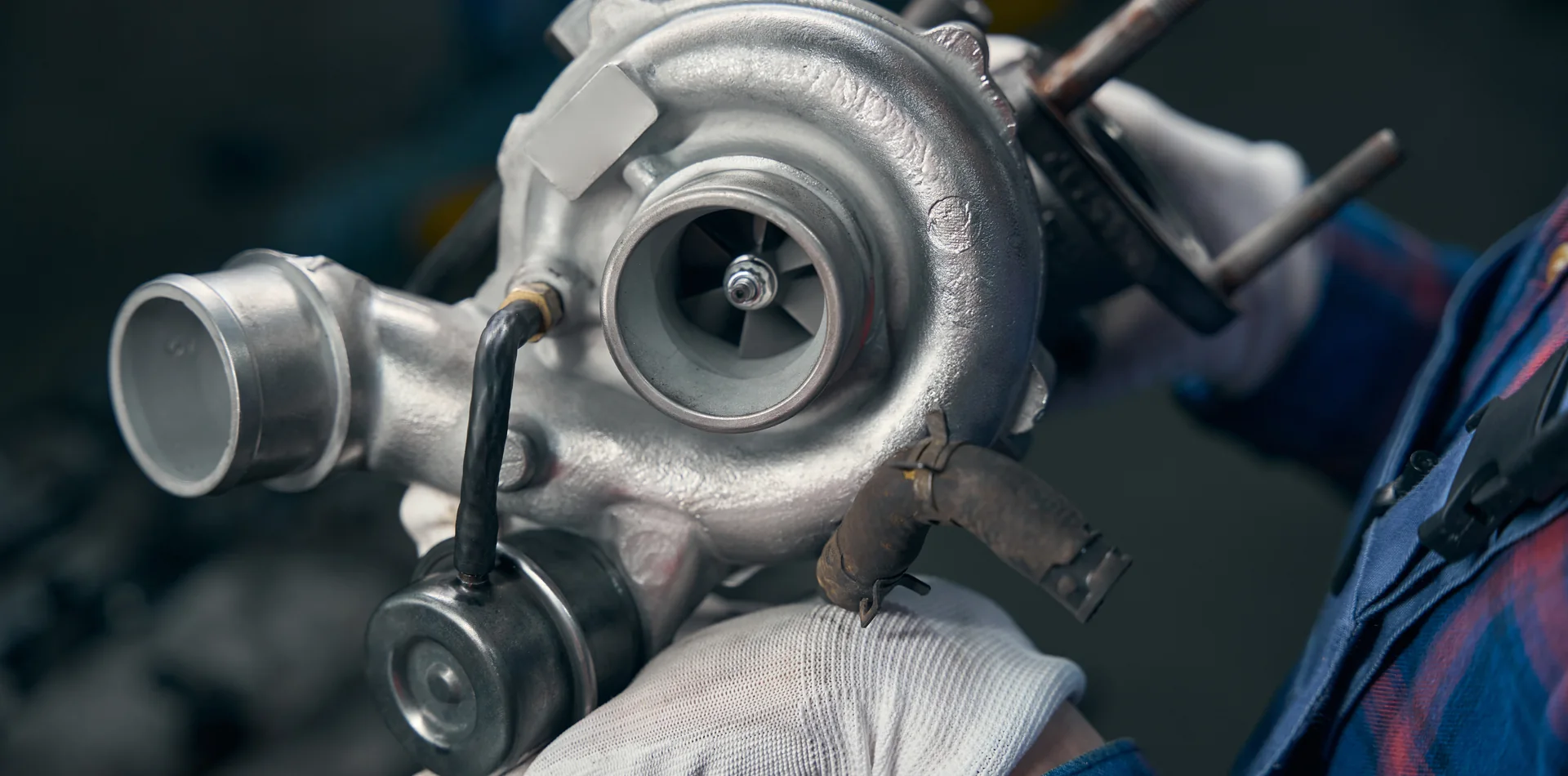
A client brought in a diesel 2.0 TDI vehicle for diagnostics. Symptoms included loss of power, turbo whistle, and boost pressure errors. Our diagnostic equipment showed slight shaft play and clogging of the variable geometry (VNT), while the cartridge and housing showed no signs of critical wear or oil consumption. The client was offered two solutions: turbocharger refurbishment or replacement with a new or reconditioned unit. The cost of the first option was 1300–2150 PLN, while the second ranged from 3800–6500 PLN. In this case, we considered repair the optimal solution, as the core of the unit was intact, and after cleaning and balancing, full performance was restored. The client saved 2500–4000 PLN.
At the same time, we also have a case where a full automatic transmission (AT) replacement turned out to be the better option. A vehicle with 240,000 km mileage was brought in. Symptoms included jerking, slipping, overheating, and limp mode. Diagnostics revealed metal shavings in the oil, wear of friction plates and the valve body, pressure drops in several channels, gear-related errors, and a history of overheating. A full transmission rebuild would cost around 7000 PLN, while a new unit costs between 13,000–22,000 PLN. A full replacement was chosen, as the wear was systemic and affected almost all components, offering no guarantee of long-term reliability, while repair costs were high and the risk of another failure within a year was not negligible. Our mechanics installed a new automatic transmission with a warranty. The client received more stable performance and avoided the need for another repair in the near future.
Need a mechanic's advice?
Turbocharger repair →